How to Test an Idea: MVP Vs POC Vs Prototype
Do you start with an MVP vs prototype vs POC? Understanding proof of concept vs prototype vs MVP is required to avoid wasting time, money, and effort.
Although these words are primarily interchangeable, they perform extremely distinct purposes. A prototype vs proof of concept comparison illustrates that one is used to test feasibility, whereas the other seeks to investigate design and user experience. Meanwhile, MVP vs POC or POC vs MVP debates assist in explaining when you’re proving it can work versus actually launching for early adopters.
In this guide, you will learn the brief distinctions, fundamental similarities, and practical examples of when to apply POC vs. prototype vs. MVP. Whether validating an idea, iterating toward a design, or getting to market fast, becoming proficient in these tools will enable you to make improved, more effective development decisions.
What is Proof of Concept (POC)?
A Proof of Concept (POC) is a small pilot project that demonstrates whether an idea, technology, or approach is feasible and works as intended. It is not meant to be a completed product, but evidence that the concept can be successfully implemented. POCs are used by companies to reduce risk, validate assumptions, and convince stakeholders before committing more resources. POC:
- Reduces risk as it reveals technical or business problems sooner;
- Saves resources as it avoids a large investment in impossible ideas;
- Builds stakeholder confidence as it shows the concept is viable;
- Improves planning as it enables more concrete roadmaps and budgeting.
Before the app development, the POC is used to confirm the potential ideas. It is available at a low cost and is a powerful tool to test the underdeveloped apps at the early stages.
How is POC created?
Creating a Proof of Concept typically involves the following steps:
- Define the objective. Clearly articulate what you are trying to prove. For example, “Can this software integrate with existing systems?” or “Will customers use this new feature?”
- Identify critical requirements. Rank the must-have elements that have to work for the idea to be viable. Ignore nice-to-have elements for now.
- Build a minimal prototype or solution. Build only what is necessary to establish feasibility. It may be a working demo, a tech integration, or a scaled-down service.
- Test and validate. Run the POC in a controlled environment. Gather results to see if it meets the success criteria.
- Document findings. Document what was successful, what wasn’t, and lessons learned. This documentation is important in order to determine the next steps.
- Present to stakeholders. Report findings and recommendations. Use the POC results to secure buy-in, funding, or permission to continue development.
POC is supposed to be an excellent option for low cost and better efficiency. POC is an excellent option to get results in a short time with limited resources.
Suppose a company wants to launch its product to understand the hidden flaws. It will use POC for capturing errors. In this way, the company will know the deficiencies and requirements to make the best product.
What is Prototype (PT)?
A prototype (PT) is an early, tangible version of a product developed to prove out concepts, design, and functionality before manufacturing or release. Unlike a Proof of Concept (POC) that proves feasibility, a prototype shows how the product looks and works. It ranges from rough sketches or mockups to interactive computer simulations or functioning physical prototypes.
Prototypes allow groups to visualize the end product, catch design mistakes early, and gather input from users or stakeholders. They reduce the likelihood of costly modifications in the future. Prototype:
- Validates design decisions before full development;
- Improves user experience through early inputs;
- Saves costs by catching errors early;
- Translates vision clearly to developers, investors, and customers.
It is an essential tool to determine the performance of the app as well as its functions. Prototyping provides quick responses and an effective way to determine an app’s deficient features. This helps in the assembly of documents and gives a proper estimation of the time of how long this will take for compilation.
How to create a prototype?
Preparation of a product prototype normally entails the following:
- Define goals and requirements. Identify what you want to test: design, usability, functionality, or technical performance. Set the scope and degree of fidelity needed.
- Sketch or wireframe ideas. Create crude sketches or diagrams to define the user pathway and organization. This low-cost stage optimizes concepts before spending money on comprehensive design.
- Produce a finished design. Use design software to create high-fidelity mockups with color, type, and genuine copy. In the case of physical products, this involves CAD modeling.
- Build the prototype. Put designs into an interactive version. For digital products, this could be a click-through app or web prototype. For physical products, use 3D printing, low-level materials, or manufacturing methods to create a functional model.
- Test with users and stakeholders. Gather feedback by testing the prototype in front of intended users or decision-makers. Document issues with usability, appearance, or functionality.
- Refine and iterate. Use the feedback to improve the prototype. Repeat the loop as required to reach the desired quality and functionality.
- Document and plan next steps. Document lessons learned and prepare for development or production, referring back to the prototype in final production.
So, a prototype helps to demonstrate the improvement of an application in its initial stages. It gives many ideas about the features and functions of the application.
What is Minimum Viable Product (MVP)?
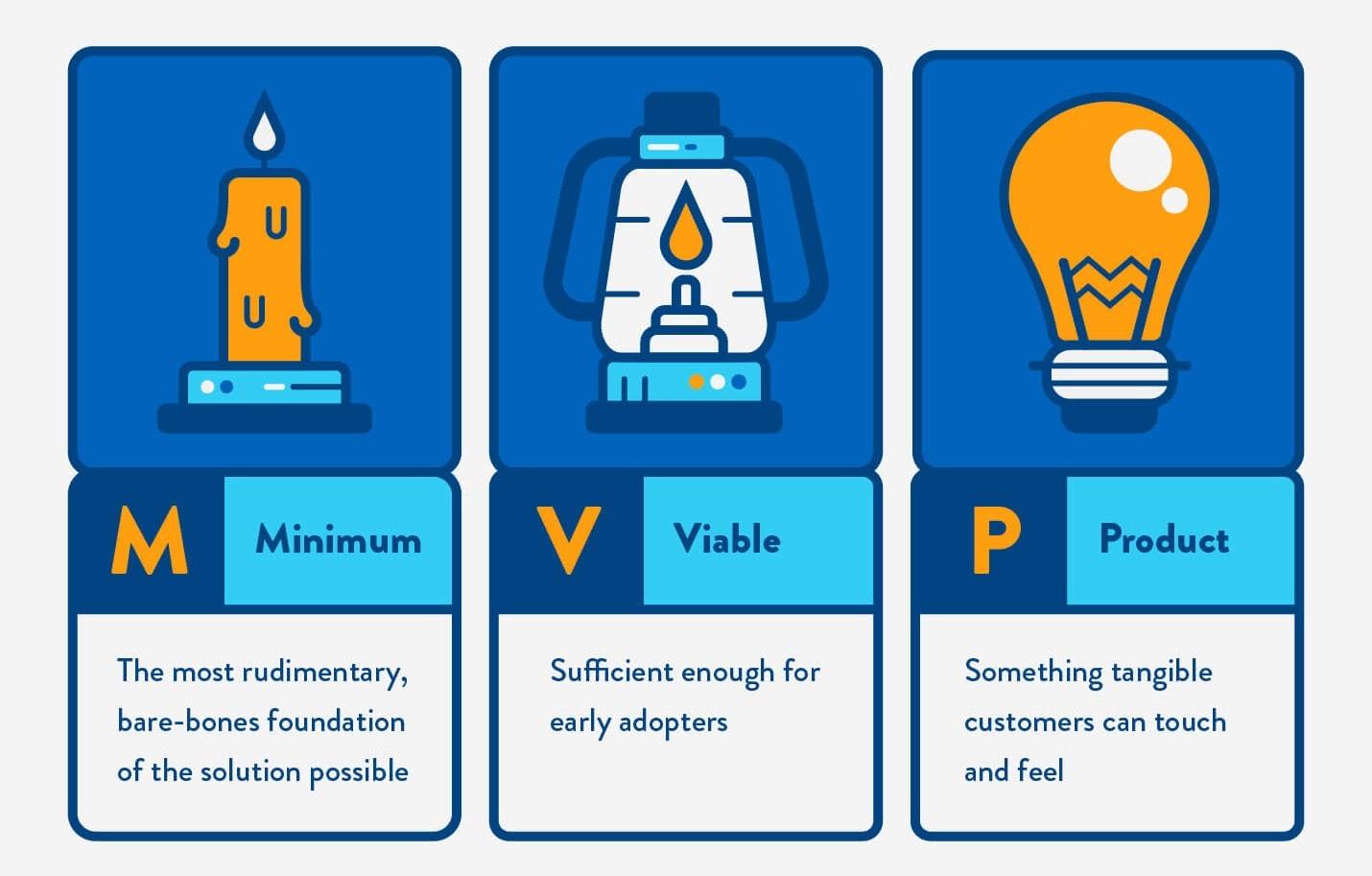
Minimum Viable Product (MVP) is a product release that includes only its core, most essential features to satisfy early users’ requirements and validate the product idea in minimal time. The goal of an MVP is to deploy with minimum effort but have enough capability to solve the root issue for the users and then learn from actual feedback in order to improve the product. MVP:
- Saves time to market by focusing on the important stuff;
- Verifies real user requirements before committing large-scale investment;
- Captures early feedback to guide development;
- Minimizes risk by avoiding overengineering of unwanted features.
Whereas a prototype is used to try and validate design or function, an MVP is a working product released to first customers to test market demand and usability.
How to create MVP?
Creating an MVP normally entails these main steps:
- Define the problem and target users. Define the problem you would like to solve and the target users. Make sure that the problem is important enough that users will pay for a solution.
- Identify core features. Select features that are definitely necessary to solve the main problem. Do not have “nice-to-have” extras here.
- Map the user journey. Design how the users will interact with the product to obtain what they require. This allows it to be easier to understand what the MVP must include.
- Design a basic, functional interface. Make clean, intuitive designs that facilitate the core functionality. The UI does not necessarily need to be final-polish quality, but clean.
- Build the MVP. Create the minimal set of functionality as rapidly and effectively as possible. Apply agile development practices or no-code/low-code platforms if applicable to accelerate.
- Test with early adopters. Launch the MVP to a small audience of actual users. See the way they use it, collect comments, and track engagement, retention, and happiness.
- Analyze results and iterate. Use feedback and data to improve the product. Add, remove, or upgrade features based on real-world usage before expanding development or marketing.
The MVP development process helps verify the team’s opinions about the application, efficiency, availability, and conventional use. Constructing the MVP helps in developing the app to accumulate users’ positive feedback.
Key differences between POC, Prototype, and MVP
| MVP | Prototype | POC | |
| Market Validation | Designed to confirm real-world demand in the market and prove users will adopt and pay for the underlying solution. | Legitimizes design, flow, and user experience before construction. | Confirms that a technical or business idea can work in principle. |
| Cost Effectiveness | Suitable for projects that have fixed budgets and need to get early customer validation and investment potential. | Most cost-effective, focusing on visualizing and experimenting with the design concept. | Very cost-effective in proving feasibility and gaining internal acceptance before incurring significant expenditures. |
| Key Objective | Develop a minimum but deployable product that solves the key issue and is sellable or usable by real customers. | Provide a realistic preview of look, feel, and navigation to use feedback to iterate on design. | Make sure the underlying idea or technology has any hope of succeeding before spending more. |
| Technical Resource Involvement | Requires all development resources, like a skeletal production project. | Very few technical resources, mainly design and UX work. | Very little technical work to prove that the underlying idea or integration is feasible. |
| User Interaction and Satisfaction | Uses real user interaction to validate some features and collect usage metrics. | Demonstrates system look and feel to stakeholders and test users for initial feedback. | Internal testing primarily, little or no end-user participation. |
| Target Audiences | Early adopters, real paying customers. | Limited groups of stakeholders, designers, developers, and select test users. | Internal teams, technical reviewers, and investors. |
| Reusability and Legacy | The first actual version of the product, ready to scale. | UI design and interaction patterns can be utilized to inform the final build. | Can be a prototype or MVP by involving feasibility early. |
| Revenue Generation | Potentially generates revenue by selling to early customers. | Not sold—internal signoff and design validation. | Not sold—used to acquire internal buy-in or money. |
| Risk Factors Associated | Low risk—tiny but real product with main features reduces uncertainty before scaling up. | Very low risk—helps test UI/UX flow and design decisions early. | Controlled risk—checks if it works before significant investments, but not for customer use. |
Let’s say you are creating a new meal ordering application:
- POC. Create a bare-bones integration to prove that restaurant menus can be pulled from partners’ systems in real time. It may just be a command-line script or server-side invocation.
- Prototype. Design clickable screenshots in a program like Figma showing how customers choose meals, schedule delivery, and pay. This enables you to test the flow with real users before coding.
- MVP. Develop a clean but fully functional app with basic features: user sign-up, menu browsing, ordering, and payment. Launch to a small market to get real orders and feedback for subsequent improvements.
Below is a comparison between POC, Prototype, and MVP, so that you can just check the differences they have in purpose, scope, audience, timing, functionality, and utilization. These differences allow teams to choose the right approach at the right phase of development.
Purpose
- POC. Proves that an idea or technology is able to work at all. It’s about technical feasibility. For example, demonstrating that an AI model is able to identify images correctly in an intended service.
- Prototype. Rehearses and refines the manner in which the solution will look and function. For example, designing an app screen flow to pilot usability before writing code.
- MVP. Delivers real value with primary features to real users. Resolves a core problem well enough to ship and demonstrate market demand. Example: shipping a lean ride-sharing product with only booking and payment features.
By the way, we recommend you read our article 5-Step Guide to Healthcare Mobile Application Development.
Focus
- POC. Technical or conceptual feasibility. “Can this work?”
- Prototype. User experience and design. “How will it look and feel?”
- MVP. Core value and market fit. “Will users adopt and pay for this?”
Outcome
- POC. Proof that the concept is effective (yes/no outcome). Outcome is a low-level test or demo, usually for internal review or investor approval.
- Prototype. Visual and functional model that renders requirements and design explicit. Outcome is a fully defined design map with user feedback on usability.
- MVP. A working, customer-facing product with minimal features. Outcome is learning about market validation and early customer adoption.
Customer Facing
- POC. Usually not customer-facing. Built for internal teams or investors to determine feasibility.
- Prototype. Usually semi-customer-facing. Shown to a subset of users or stakeholders in order to be able to receive feedback.
- MVP. Customer-facing. Shipped to real users to be able to learn from real-world use.
Degree of Functionality
- POC. Bare minimum functionality to prove a major technical concept. No UX or production quality. E.g., a script that illustrates two systems can talk.
- Prototype. Dummy or incomplete functionality with actual design. E.g., interactive app screens with no backend.
- MVP. Only minimum production-quality features. E.g., a live app for sign-up, search, and buy, but no in-depth personalization.
Audience and Timing
- POC. Pre-production phase. Internal teams, technical decision-makers, and investors. Hired before full development commitment.
- Prototype. Mid-point stage. Designers, developers, gated users. Used before coding the final version to test concepts.
- MVP. Advanced phase. Early majority and real customers. Used to go live right away and validate market hypotheses.
By the way, we recommend that you read our article Gemini vs ChatGPT: Compare Popular AI Tools.
What to select: POC vs Prototype vs MVP?
To check the apps’ feasibility and requirements, you should pick one of the tools that can give the best results in the end.
Select MVP when:
- You require the highest retention on a low budget;
- You have to show a working app for clients;
- You know the market perception to improve the application for development purposes;
- Your goal is to make money.
Select POC when:
- Seed-stage funding is needed;
- You want to check if your ideas are working well or not;
- You want to share internal information and scenarios with your team;
- You want an approach that features successfully in a fast way.
Select prototype when:
- There is a shortage of technical approaches and availability;
- Money and time are limited, and you want to show your products to the client as soon as possible;
- You have a short time to look for your application.
If you want to create a project in the healthcare domain, we recommend you read our article How to Make Your Mobile App HIPAA Compliant.
Similarities between POC, Prototype and MVP
Although different from one another, proof of concept vs prototype vs MVP possess crucial similarities that make them a central part of product development in the modern world. The similarities ensure teams create solutions that accurately solve user problems without wastage and risk.
Iterative Approach
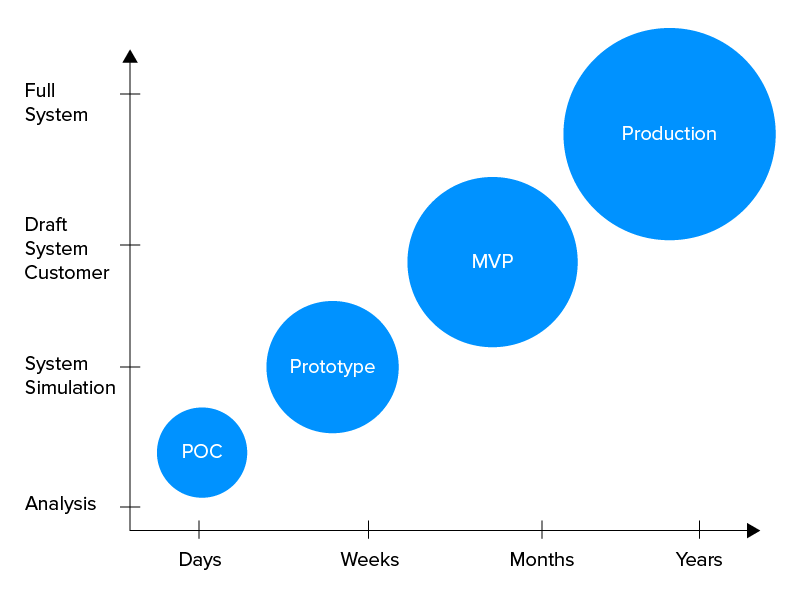
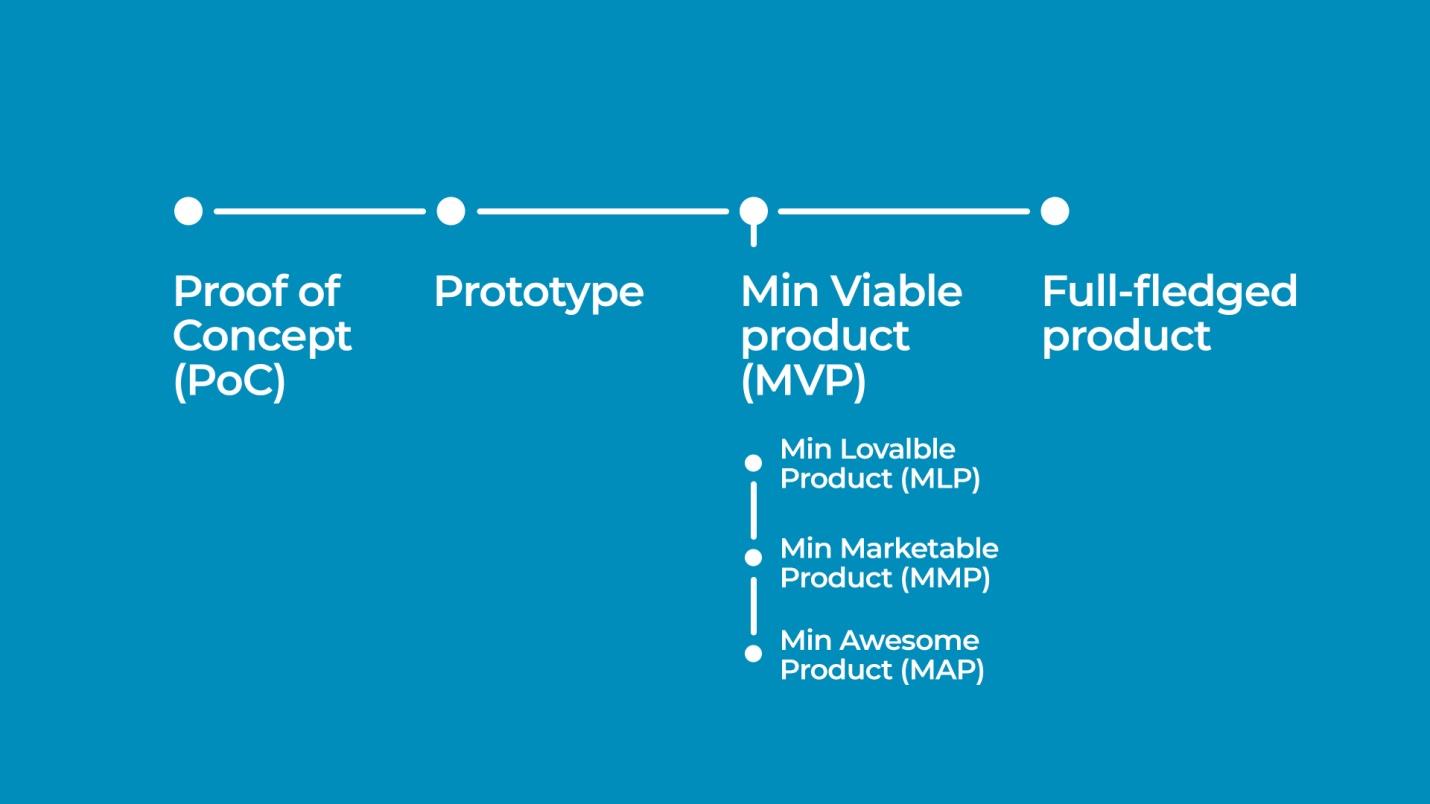
All three—POC vs prototype vs MVP—have the iterative mindset. Rather than building the entire solution all at once, they focus on developing in small, testable bites. It’s how teams are able to adapt based on findings along the way.
Want an example? A FinTech business might first show that a blockchain payments system would be viable (POC), next develop easy-to-use screens (Prototype), then launch a limited-set-of-features payments app (MVP) to early adopters. Each stage advances the idea before scaling.
User-Centered Design
Regardless of whether it’s POC vs MVP vs prototype, they’re all centered on user needs. Even if the target audience differs (internal teams for POC, stakeholders for Prototypes, actual users for MVP), the end result is the same: ensure that the final product actually solves user problems.
Want an example? An e-learning company might build a POC to:
- Show AI-generated quizzes work;
- Build the quiz interface as a prototype to get feedback from teachers about usability;
- Release an MVP platform to early customers to validate demand and obtain feedback.
If you want to profitably monetize your idea, we recommend you read our article 6 Trusted Mobile App Monetization Strategies.
Learning and Validation
At their core, MVP vs prototype vs POC all serve a function of learning and validation. Each step is a controlled experiment to reduce risk and develop confidence before committing full investment.
Want an example? A health-tech startup might do a POC to prove sensor accuracy, prototype app user experience for patient usability, and ship an MVP to test adoption in a pilot clinic. Each phase verifies the assumptions while guiding development.
Examples of using a prototype vs MVP vs PoC
It’s easier to understand POC vs prototype vs MVP through examples in real life. Here’s one example of how firms choose each one for different stages of product development.
Example 1: Fintech App
- PoC. Verify if secure bank-to-bank transfers can be accomplished with the use of blockchain. It’s a backend proof-of-concept with no customer-facing UI, demonstrating that it can be accomplished.
- Prototype. Build interactive app screens showing how customers will request and track transfers. Stakeholders and testers review the look and flow before coding.
- MVP. Build and launch an app with just the most important transfer and balance functionality for early customers to test genuine demand and generate feedback.
Example 2: Smart Home Device
- PoC. Wire up sensors and controllers on a breadboard to prove the device can detect motion and send alerts. This confirms technical feasibility.
- Prototype. 3D-print a case and make a working demo with buttons, LEDs, and an app mockup to illustrate how it will be shaped and operated.
- MVP. Make a small batch of finished units with primary features standalone, and sell them to early adopters to test market fit.
Example 3: SaaS Collaboration Platform
- PoC. Create a minimal integration to confirm your software can sync with typical calendars. No UI, just to demonstrate it can be accomplished.
- Prototype. Create a click-through in Figma or Adobe XD that shows workflows for event creation and sharing. Used for stakeholder validation.
- MVP. Ship and launch a working platform with essential collaboration capabilities like task delegation and document sharing for paying early adopters.
We recommend you read our article, Top 10 Hot AI Startups In 2025 You Must Be Aware Of. All of them have been POC, prototype, and MVP tested.
Why Choose OS-System for Your PoC, Prototype, or MVP Development?
More than good ideas are needed to turn an outstanding idea into reality. Success is about the expertise, good strategy, and the technical know-how.
And that is where we come in.
Our specialists have advised startups, scale-ups, and enterprises through the entire POC vs prototype vs MVP process. We are aware of the important differences—and how to apply each strategy at the right moment. Our pros:
- Full-cycle support. Initial discovery workshops, design, development, launch,and more – we guide you through each step.
- Risk mitigation. We allow you to test feasibility, iterate on designs, and test market appetite prior to committing big budgets.
- User-centric approach. We don’t just build features—we solve issues that your users actually care about.
- Fast time to market. Our agile methodologies and experienced team save you time to get your idea in front of customers.
- Technical excellence. Blockchain and AI PoCs, polished mobile MVPs etc – we bring lengthy technical experience.
Contact us today to find out how we can help you choose the optimal path—PoC, Prototype, or MVP—and get your idea into market with confidence.
Conclusion
From learning many aspects of POC vs PT vs MVP, we conclude that every tool has different features that can be used according to the requirements. No single tool is the winner of the article because every tool is needed per the specific conditions.
These methods are cost-efficient and help you learn the lacking features and characteristics of the app very quickly. All these tools help to improve the development of app features that need to be done in a short time. This article gives many beneficial ideas to increase the efficiency of applications in the market.
These tools ensure that everyone, i.e., manufacturers, stakeholders, clients, and the team, is on the same page. They also help to eliminate typical mistakes and get better results.
Each method is supposed to be advantageous because it provides winning over clients, valid marketing, and testing critical business concepts. All these produce remarkable and useful results, which lead to success. With a piece of better information and understanding of PTs, POCs, and MVPs, you will be able to prevent and cover the mistakes to increase your chances of success. We hope this article was helpful to you!
![]()
Subscribe to us
CONTACT US
THANK YOU,
VLAD ABAKUMOV,
WE WILL GET BACK TO YOU SOON
Your Email has been sent! We appreciate you reaching out and are stoked about the opportunity to work together. Stay tuned and we will get back to you soon.